Investing in roll-forming technology? What sits behind a Howick machine competitors cannot copy
⏱️ 8 min read
No time? Here is what you need to know
- Howick innovation starts with the real construction problem, then works back to the machine, connection detail or production method that solves it.
- First-principles engineering shapes Howick's product evolution, from end-bearing stud details and telescopic framing to open CSV control, rivet systems and the structural framing capabilities of X-CALIBR™.
- A Howick machine does more than produce framing. It removes measuring, marking, cutting, drilling, sorting and the rework that slows conventional construction.
- Customers including M3 Components, Remagin Ireland, Uniplan, Wernick Buildings, Queensland Steel House Frames, British Offsite, Wolf Partners and Frameclad are applying Howick technology to improve speed, flexibility, quality and construction certainty.
- Competitors can imitate a visible machine feature. The engineering knowledge, testing discipline and process logic behind the feature are what create the difference.
Have you wondered how Howick is different from the competitors that copy its machines? If you are researching which roll-forming technology to invest in, what sits behind a Howick machine will shape your decision more than any visible feature. Why? It is more than the sum of its features. It is the engineering thinking, the customer problems it was built to solve, and the rigorous testing that proves it works.
When a competitor copies a Howick stud detail, they get the shape but not the reason it exists. Howick's end-bearing stud was not designed to be different. It was designed because, on a 10-storey building, light gauge steel studs could potentially compress screws and cause the structure to fail. Solve that, and the visible feature follows.
Real engineering solves the problem first. The machine and tooling come second. That is how Howick has built a global reputation for innovation in roll-forming technology. The same thinking sits inside the X-TENDA™ 3600, the open CSV pathway, the floor joist tab connection, the rivet truss system and X-CALIBR™. It is also why customers from Wernick in the United Kingdom to M3 Components in California, USA are using Howick technology to change the economics of how they build.
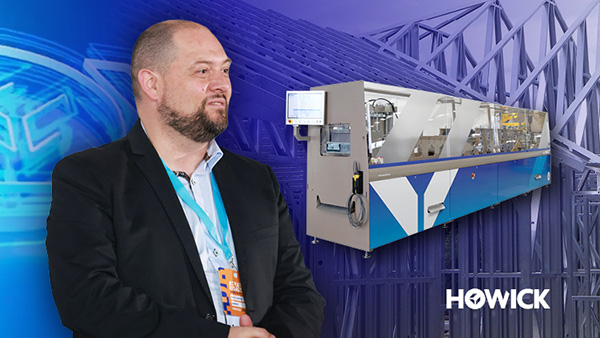
For Nick Coubray, CEO of Howick, the machine is never the starting point.
"It is a why are you doing it? What is your real problem?" He describes Howick as "a first-principles engineering company which makes products," focused on finding "the right solution for what you are trying to achieve." - Nick Coubray
This approach matters because construction's biggest problems sit in the handovers between design, manufacturing, logistics and site. McKinsey points to a productivity lag the sector has carried for decades, with industrialised systems holding the largest upside. UNEP's Global Status Report for Buildings and Construction attributes 32 percent of global energy use and 34 percent of CO2 emissions to the sector. Waste and rework are no longer affordable on either count.
"Howick's innovation works on the two pressures the construction industry feels most: productivity and material waste." - Nick Coubray
Table of Contents
- Innovation has shaped Howick since day one
- The Howick way starts with real construction problems
- Machine capability that removes work from the process
- Customer proof: innovation working in the real world
- Queensland Steel House Frames: built on Howick
- Remagin Ireland: design, manufacture and installation in one
- Uniplan Group: from timber waste to steel certainty
- Wernick Buildings: steel for modular volume
- Wolf Partners: vertical integration through Howick
- Frameclad: flexibility that scales
- M3 Components: scaling around Howick output
- Product evolution shaped by site realities
- X-TENDA™ 3600 and telescopic framing
- Floor joist tab design
- Truss system and hollow rivet design
- X-CALIBR™ roll-formed structural system
- Why copied features miss the point
- Why Howick innovation matters to construction businesses
- Common questions about Howick and its innovation
- Conclusion
Innovation has shaped Howick since day one
Howick's innovation story begins with engineering discipline. A Howick machine turns coil steel into cold formed steel components that arrive ready to assemble. The machine takes design data and converts it into studs, tracks, joists, truss components and specialist profiles. The required cuts, punches, fixing locations, service holes, dimples, swages and connection details are all formed in sequence.
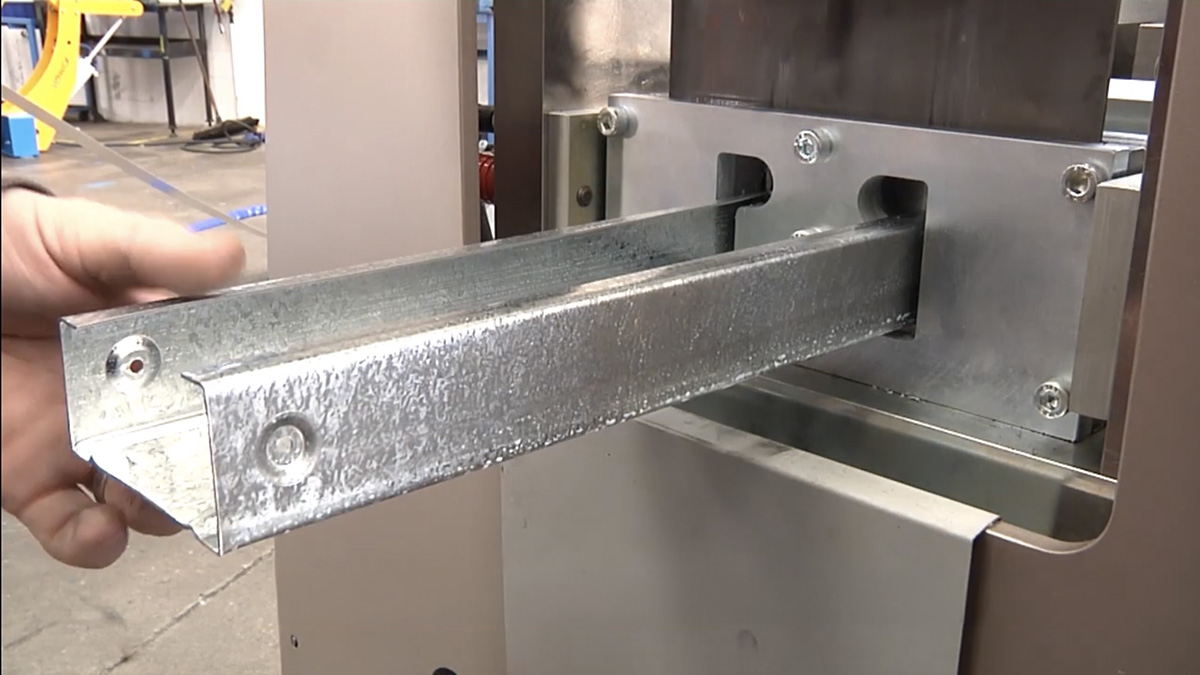 Howick’s True Load-Bearing Joints
The construction benefit is direct. Crews spend less time measuring, marking, cutting and drilling. Manufacturers can produce ordered kitsets that match the design file. Installers receive components that locate, align and assemble with less interpretation onsite.
Howick's engineers ask what work the machine can remove from the build.
"The commercial logic for our approach to innovation is simple. Solve the underlying engineering problem first. You cannot compare a length of product with a length of product, you have got to compare it with what it is doing." - Nick Coubray
The cost of a component includes the labour to source it, move it, measure it, cut it, drill it, fix it, check it and correct it. The value of a machine sits in the work it has already done before that component reaches the installer.
The Howick way starts with real construction problems
Construction teams often describe the product they think they need. They ask for a hole, a bracket, a profile, a panel or a machine. Howick asks what that component needs to do.
The end-bearing stud detail gives a clear example. Nick traces the innovation back to a structural engineering problem on taller buildings. If the studs compressed and moved on screws, the building could fail. Howick's answer required accuracy, tooling, punches, cuts and a simple way to combine the details that made the system work.
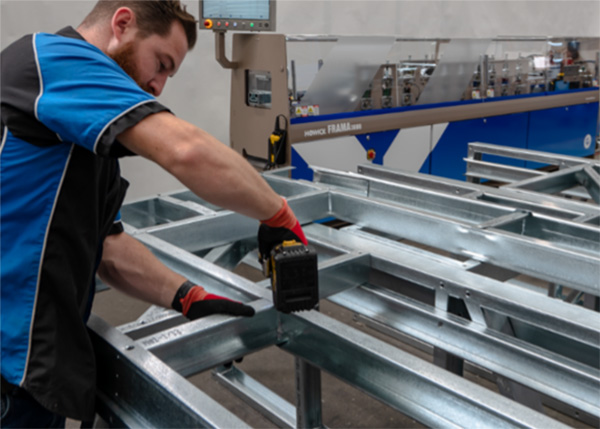
"Others have tried to copy the visible feature, but they do not know why it does what it does or how it works." - Nick Coubray
Howick innovation begins with understanding the problem to be solved. Knowledge of the problem, not the idea alone, is what shapes the answer.
"How simple can we make this? It is really easy to make it complex. It is really hard to make it simple." - Nick Coubray
That discipline shows in the open CSV approach. Howick wanted a simple machine language that could work with different software platforms rather than locking customers into one closed ecosystem. The benefit is practical fault-finding and flexibility. If the file says move 1000 millimetres and punch a web hole, the machine either follows that instruction or it does not. The customer can see whether the issue sits in the design file, the output or the machine calibration.
Howick machines work with multiple CAD platforms, giving customers the freedom to use the design workflow that suits their business.
"With no ongoing software licence fees or meterage rates, customers get to focus on production output and machine utilisation. There are no recurring charges tied to every metre of steel output." - Nick Coubray
Machine capability that removes work from the process
A Howick machine does more than roll-form steel. It turns design intent into accurate, ready-to-assemble building components.
Each stud, track, joist or truss component can be cut, punched and formed in sequence, with the detail needed for assembly already built in. Dimpled holes support accurate alignment. Swaged ends of studs help components sit cleanly together. Service holes, fixing holes and connection points can be placed as part of the same production process.
The commercial benefit sits downstream:
- less site measuring
- less cutting
- less drilling
- no loose parts
- cleaner assembly
- and fewer instances of rework.
Howick machines produce components to exact measurements, right down to the millimetre (or 3/64 inch). Parts arrive ready to locate and fix, so assembly is faster, build quality improves and rework requirements are cut.
The same logic applies to mobility and deployment. Howick mobile factory solutions place machines in shipping containers, so customers can manufacture onsite or relocate production when the project requires it. For customers operating across remote, temporary or high-pressure environments, production moves closer to the point of use, reducing transport costs and wait times.
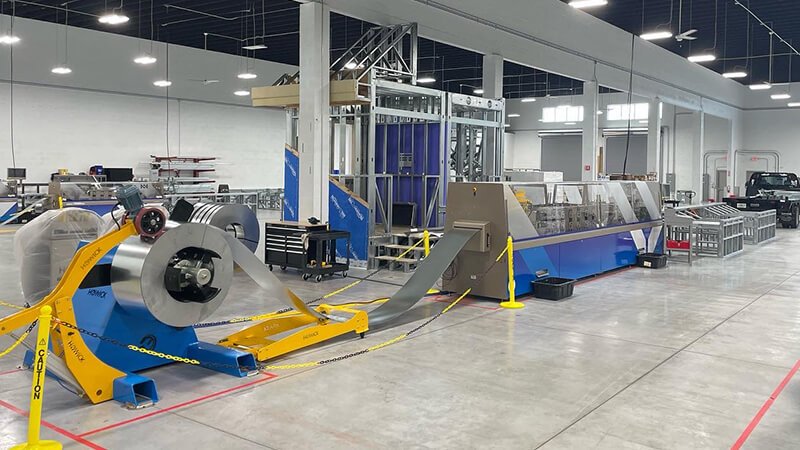 Wolf Partners
The machine also supports a wider business model. A manufacturer can move from supplying bundled steel profiles to supplying flat-packed single profiles, panelised wall sections or semi-assembled panels, depending on the customer they are serving. A builder can reduce dependence on onsite cutting. A modular business can bring framing production closer to its factory process. A contractor can standardise more of the work before the crew reaches site.
Customer proof: innovation working in the real world
The strongest innovation story is demonstrated by how the technology changes how Howick's customers build.
Queensland Steel House Frames: built on Howick
Owner and founder Brett Smith moved from traditional timber carpentry to steel framing and built Queensland Steel House Frames into the leading steel house frame supplier in Queensland, now running around ten Howick machines across its factories. Brett's original brief was "a steel frame and steel truss system that was going to be better than the rest", easier to install and easier for following trades.
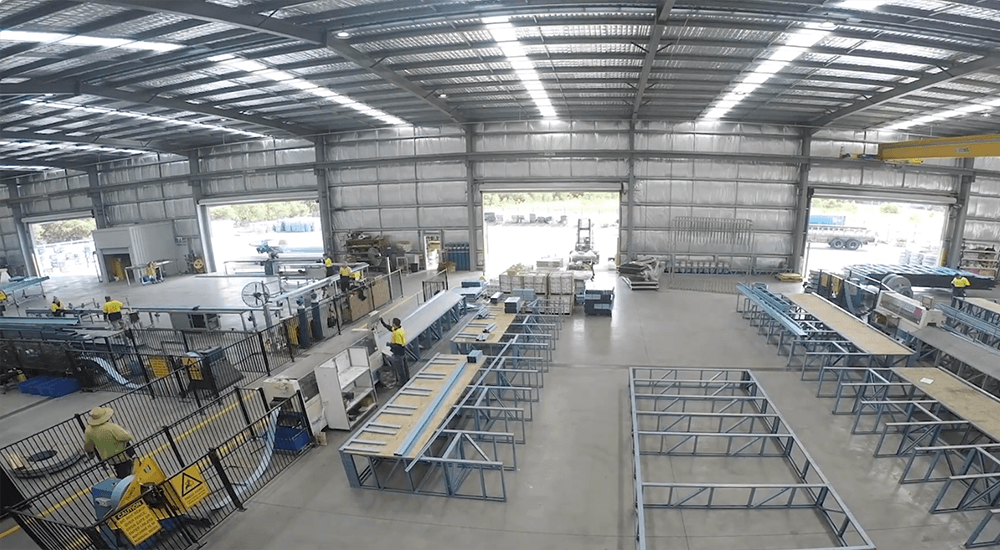 Queensland Steel House Frames
Remagin Ireland: design, manufacture and installation in one
Remagin Ireland combines design, manufacture and installation into a single-source offsite solution, operating four Howick machines. Country manager Ger Fahey says Remagin takes account of "fire, acoustics, thermal, and weathering" to deliver "the best value" for the client. The full-service model depends on controlled manufacturing and site-ready installation.
Uniplan Group: from timber waste to steel certainty
Australian modular builder Uniplan Group switched from timber to light gauge steel after waste, inaccuracies and staff injuries became constraints. Since adopting Howick technology, Uniplan builds faster and safer with almost no waste. Then-factory manager Nick Kelly: "We used to fill a full bin full of timber waste every day. Now that little bin we have got there, we change that out once a month, fully recycled." Three years in, Uniplan reports zero downtime on its Howick FRAMA™ 3200.
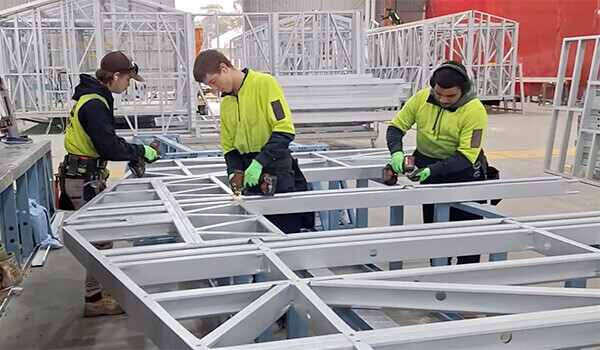 Uniplan Group
Wernick Buildings: steel for modular volume
Wernick Buildings is transitioning from timber to light gauge steel after timber created waste, combustibility risk, storage demand, weight, dust and high rejection rates. Since introducing a Howick roll-forming machine, the factory has run a zero rejection rate on steel components, and offcuts are recyclable. Production manager Tom Rhoden also points to "thousands of linear metres of storage capacity within a really small space", production capacity in disguise.
Wolf Partners: vertical integration through Howick
Tampa-based Wolf Partners runs a vertically integrated development, architecture, fabrication and building model to remove inefficiencies. Co-founder and principal Adam Wolf: "I was always passionate about how we can use the computer to develop new types of architecture, new building practices. That is kind of what we do here."
 West Bay Townhomes, Hyde Park, Tampa, Florida.
Frameclad: flexibility that scales
Frameclad, one of the United Kingdom's leading light steel framing manufacturers, runs an end-to-end service from design through to flat-pack delivery of single profiles or panelised systems. Across two factories in the West Midlands, the business operates seven Howick roll-forming machines, with load-bearing frames now making up 75 percent of production.
Joint managing director Martin Jamieson sums up what the technology delivers: "If you want a linear metre of metal, you can have a linear metre of metal. If you want a 10-storey building, you can have that as well, and anything in between."
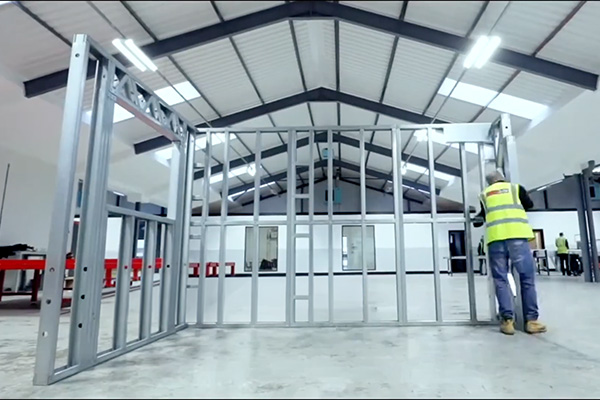 Frameclad
M3 Components: scaling around Howick output
M3 Components gives the clearest timed proof of the productivity gains from moving to a controlled manufacturing process. Using a Howick FRAMA™ 7600, they compared three methods for building medical exam rooms: traditional stick framing, a pre-cut "kit-of-parts" and fully panelised walls assembled offsite. Traditional framing took 7 hours to complete, the kit-of-parts 3.5 hours, and panelised construction less than 30 minutes, 14 times faster than traditional framing. Josh Walker, General Superintendent at S+B James, described the panelised system as "more efficient, much less labour intensive and much safer."
Across these businesses, Howick technology moves more work into a controlled manufacturing environment without losing the flexibility that real projects demand.
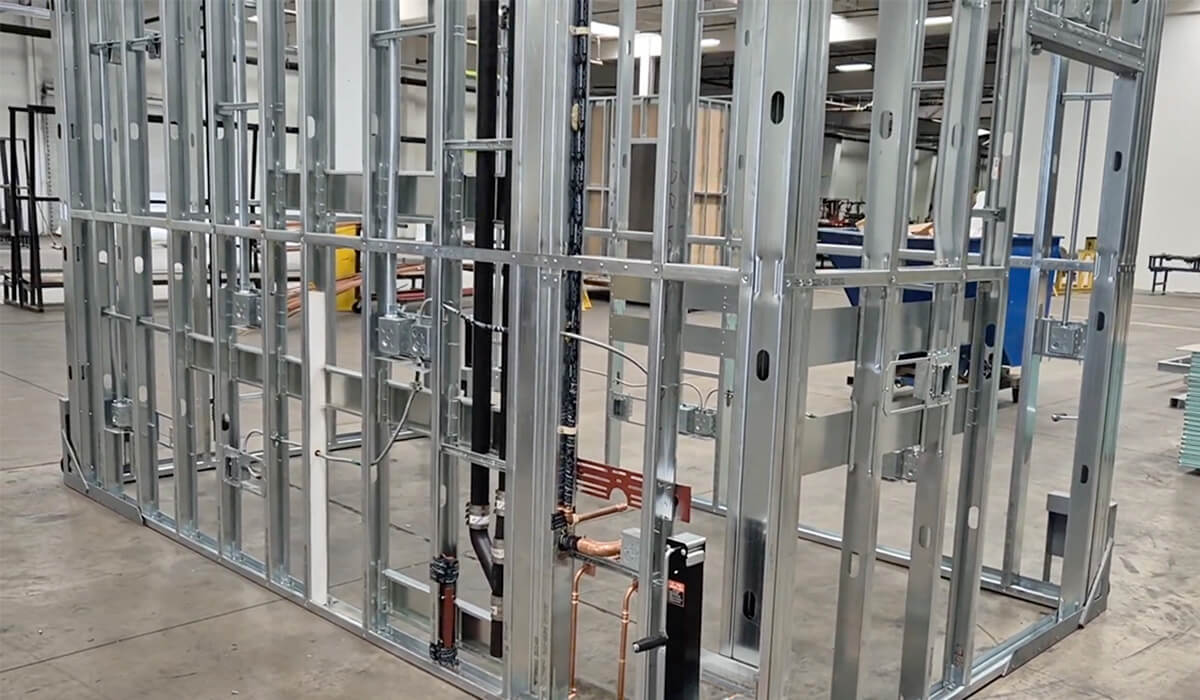 M3 Components
Product evolution shaped by site realities
Howick's most important innovations come from the gap between how construction gets drawn and how construction gets built.
X-TENDA™ 3600 and telescopic framing
The X-TENDA™ 3600 was a world first. Site dimensions change. Installers measure, snip, refit and absorb the cost of small errors multiplied across large projects. X-TENDA™ 3600 produces extendable framing panels that compress for transport and expand onsite to fit the space.
Nick explains that the problem behind the innovation was the chain of labour and uncertainty around site measurement. Howick's answer was to give the panel the flexibility to fit any space fast, while still including the fully featured elements required for a usable framing system.
On the Victoria Lane Apartments project, telescopic framing was used across 12 floors to create framing for 123 apartments. Contractors reported a 50 percent reduction in installation time compared with stick framing.
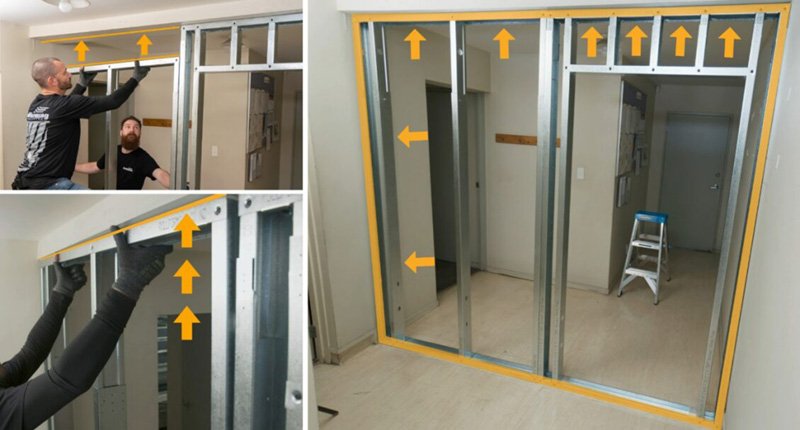 Howick’s X-TENDA™ Telescopic Panels
Floor joist tab design
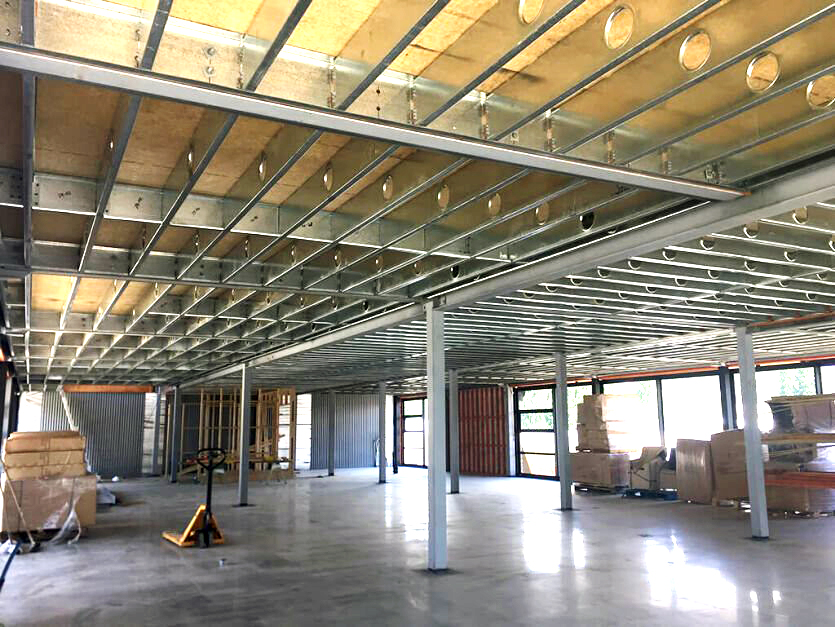
The brackets used to join floor joists are expensive and labour intensive to produce. They require purchasing, stock control, drilling and extra handling onsite. Howick's response was a standardised connection geometry formed into the joist itself, designed to work across multiple Howick framing platforms. The integrated connection detail replaces the separate bracket while keeping assembly simple and repeatable across system types.
 |
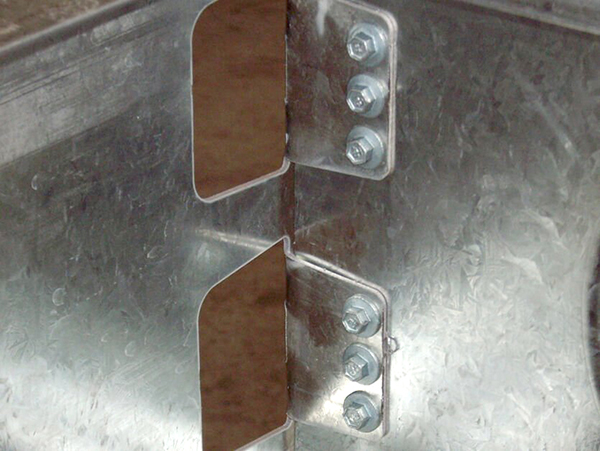 |
Howick’s Steel Joist System
X-CALIBR™ roll-formed structural system
Howick applied the same thinking to X-CALIBR™ for large-span portal frame construction. The system produces precision roll-formed structural steel sections for portal applications, with connection details formed for fast, repeatable assembly. X-CALIBR™ takes a different approach to conventional hot-rolled steel construction, replacing many of the cutting, drilling, welding and coating processes typically associated with hot-rolled steel with a streamlined roll-forming and manufacturing workflow. By shifting more work into a controlled factory environment, customers gain greater accuracy, consistency and installation efficiency.
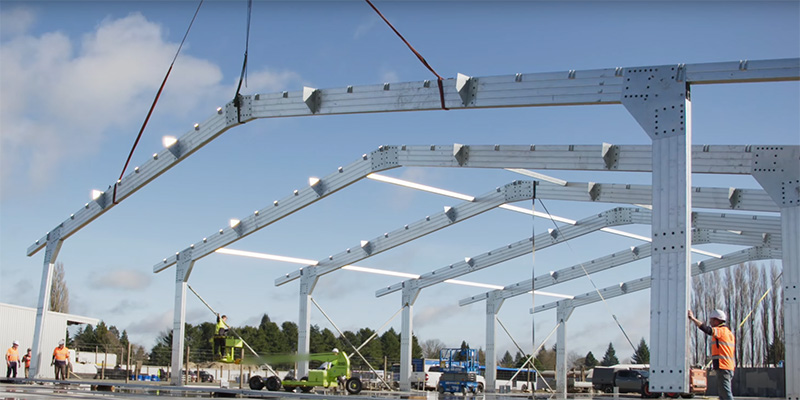 Howick’s X-CALIBRTM roll-formed structural system
Why copied features miss the point
Competitors have copied many of Howick's successful innovations. Howick knows that well.
The temptation is to compare feature with feature: one end-bearing detail, telescopic system or software pathway against another. Nick argues that this misses the point. The visible feature is only the part of the system the market can see.
"In roll-forming, performance depends on the relationship between material composition, tooling, punching, cut sequencing, tolerances, calibration, software output, assembly logic and the final structural requirement." - Nick Coubray
A copied detail may look familiar. It still must survive manufacture, transport, installation, inspection and long-term building performance.
In one example, Howick helped a manufacturer move from three machines to one roll-former, reducing the factory footprint from around 500 square metres to around 20 square metres. Cycle time fell from around eight minutes to around 13 seconds per component. Nick says the speed gain was valuable, but the original problem was production capacity and process complexity. Solve the right problem, and the operational numbers follow.
That kind of innovation depends on accumulated knowledge. It depends on knowing where tolerances matter, where they do not, which surface the customer sees, which clearance affects the punch, and which downstream process can be removed. The feature alone cannot carry that knowledge.
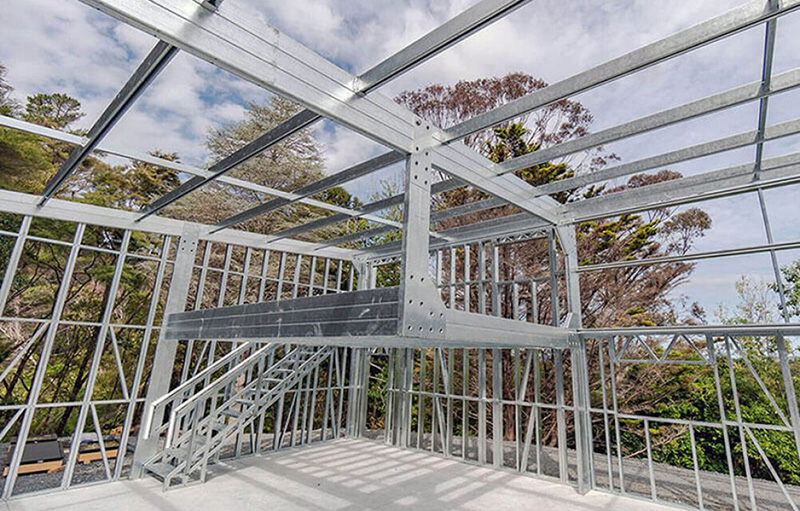 Howick's Matakana Shed project
Backing up innovation with proven quality and reliability
Innovation does not survive in construction without proof. Drawings and prototypes have to become reliable products.
A roll-forming machine is a controlled manufacturing environment for turning design information into repeatable construction components. Machines must produce components within tolerance. Connection details must perform as designed. Software output must translate accurately into cut, punched and roll-formed steel. That discipline matters because customers build businesses around the machine.
Uniplan reports its Howick machine has "never let us down" and that the business has not lost production time through the machine in more than three years. Wernick chose Howick after comparing roll-forming machine suppliers and visiting other offsite construction businesses. Tom Rhoden says technical support played a major role in that decision.
Innovation is not finished when the machine leaves the factory. Customers need training, support, maintenance, software flexibility and a machine platform that can keep working as their business grows.
Nick also makes an important point about Howick's attitude to patents. While some technologies justify formal protection, Howick patents very little. The value sits in the knowledge that goes into component innovation: the materials, clearances, pressure, tooling behaviour and long-term production experience. That expertise is what competitors find difficult to replicate.
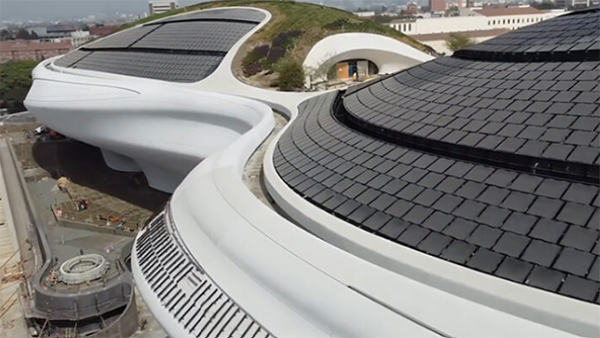 STUD-IO used computational design and Howick technology to design this curved roof for the Lucas Museum in LA. Image courtesy of STUD-IO.
Why Howick innovation matters to construction businesses
Construction leaders do not buy innovation for its own sake. They invest when a system helps them build more profitably, more accurately and with less risk. Howick innovation gives businesses the ability to solve construction challenges with better process design.
The World Green Building Council attributes 39 percent of global energy-related carbon emissions to buildings: 28 percent from operating them, and 11 percent from the materials and construction work that put them up. Howick's innovations contribute by reducing waste, improving material efficiency and reducing unnecessary site processes to tackle productivity and environmental pressure together.
For Nick Coubray, that remains the point of innovation:
"It is not innovating for the sake of innovation. It is for a reason. There is a goal." - Nick Coubray
Common questions about Howick and its innovation
Why is Howick known for innovation?
Howick is known for innovation because its machines solve practical construction and manufacturing problems. The company has developed roll-forming technology that turns coil steel and digital design data into accurate, ready-to-assemble components for frames, trusses, floors, modular construction, telescopic infill framing and specialist structural applications.
How does Howick approach product innovation?
Howick starts with the customer's real construction or manufacturing problem. The team works back from the outcome required, then develops the tooling, connection detail, software approach or machine platform that can solve it in production. Nick Coubray, CEO, describes Howick as "a first-principles engineering company which makes products."
What are examples of Howick innovation in practice?
Examples include Uniplan's switch from timber to steel, Remagin Ireland's single-source offsite solution, Wernick Buildings' modular production improvements, Queensland Steel House Frames' growth with around ten Howick machines, Frameclad's flexible production model, Wolf Partners' integrated delivery model and M3 Components' scalable offsite model.
Why does first-principles engineering matter in construction technology?
First-principles engineering helps teams identify the true challenge to tackle before they build a solution. In construction, the obvious request may be a component or feature. The real problem may be labour, tolerance and downstream waste.
Why does Howick avoid locking customers into one software system?
Howick's open approach gives customers flexibility to use the software that suits their workflow now and as their business changes. The machines work with multiple CAD platforms and avoid ongoing software licence fees and meterage charges, so customers can keep control of their production costs as they scale.
How does machine innovation reduce construction costs?
Machine innovation reduces cost when it removes unnecessary work. For Howick customers, that can mean fewer brackets, less cutting, less drilling, reduced stock management, fewer measurement errors, better software-to-machine transfer, faster assembly and less rework.
Can copied features deliver the same result?
A copied feature may look similar. Performance depends on the engineering system behind it: tooling, tolerances, material behaviour, cut and punch sequence, testing, software control, support and production knowledge. Nick Coubray's view is that imitators may copy the visible feature while missing why it works.
Conclusion
Howick innovation shows up in the practical work of designing, testing, manufacturing and supporting machines that solve real construction problems.
The strongest proof comes from the customers who apply Howick technology to solve their own production problems.
For the construction industry, the question is becoming more urgent. Builders need faster programmes, fewer callbacks, better material efficiency, more predictable costs and systems that turn design information into accurate, buildable components. Manufacturers need equipment that supports growth rather than locking them into a narrow process. Engineers need details that work in practice.
"Howick's advantage sits in the thinking behind the machine. It starts with the problem worth solving, then applies decades of construction and roll-forming knowledge to make the answer simpler, stronger and more useful for the people building with it." - Nick Coubray


